
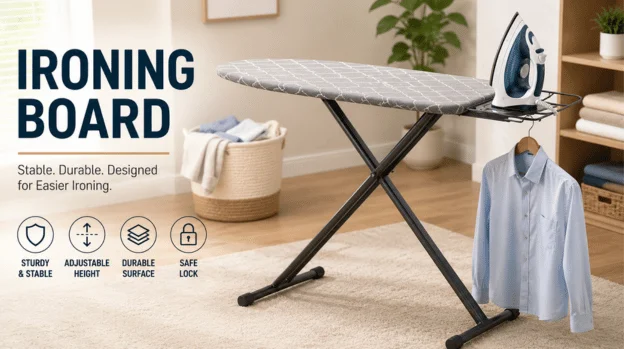
A good ironing board should feel stable, sit at a comfortable working height, and suit the way you handle laundry. Size matters, but so do storage space, the type of iron you use, and the quality of the frame. Current UK buying guides identify stability, adjustability, surface size, and easy storage as some of the main features worth checking. UK boards commonly range from about 110 cm to 135 cm in length. Widths are often around 35 cm to 45 cm, although dimensions vary by manufacturer.
| Ironing Board | What to look for |
| Surface size | Enough room for the clothes and linen you iron |
| Stability | Wide feet, a firm frame, and minimal movement |
| Height | Enough adjustability for a comfortable posture |
| Iron support | Suitable for a steam iron or steam generator |
| Storage | Folded dimensions that fit your available space |
| Cover | A secure fit, useful padding, and good condition |
| Safety | A reliable locking system and non-slip feet |
How to Choose an Ironing Board That Fits Your Home

1. Start with the surface size.
A larger surface means less repositioning when pressing shirts, trousers, bedding, and table linen. John Lewis says boards generally range from roughly 110 cm to 135 cm long and 35 cm to 45 cm wide. Larger models can speed up bigger laundry loads, while compact ones are easier to move and store.
Which? lists common size bands from Size A at 110 x 30 cm to Size E at 135 x 49 cm. It also warns that manufacturers do not always follow these dimensions exactly. Check the product measurements rather than relying on the size letter alone.
2. Put stability ahead of extra features.
A wide surface is not useful if the frame moves whenever you apply pressure. Look for broad feet, non-slip ends, a firm frame, and a locking mechanism that holds securely.
Stability is a major part of Which?’s testing. Its testers assess movement during normal use and measure how easily a board can tip or slide.
For households where furniture also needs to save space, the same practical approach applies elsewhere. Topicley’s guide to space-saving armchair beds is useful when planning rooms in which every item needs a clear purpose.
3. Check the height range.
The right working height helps you avoid leaning over the surface for long periods. Adjustable models are useful when several people share laundry duties. Brabantia’s guidance places many standing working heights at roughly 90 cm to 102 cm, while some adjustable models can go low enough for seated use. Exact settings differ by model. Do not buy based on maximum height alone. Make sure the adjustment range suits both the shortest and tallest regular users in your household.
4. Match the support to your iron.
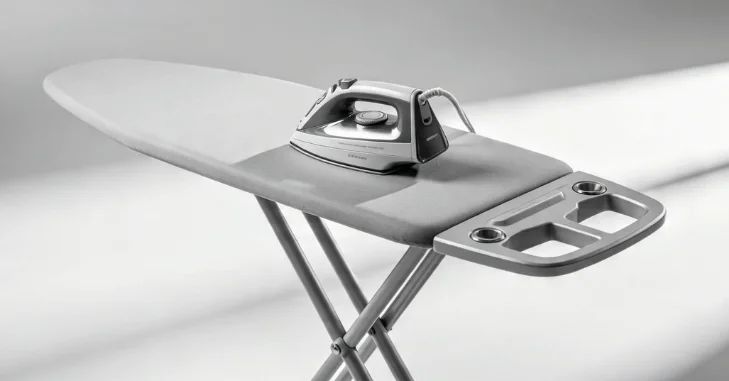
A standard steam iron needs much less resting space than a steam generator. If you use a steam generator, check that the holder is designed for its size and weight. Current UK buying guides distinguish between ordinary boards and models made for steam generators. Larger, steam-generator-friendly designs provide a wider support area but usually require more storage space.
5. Measure the storage space first.
Measure your cupboard, utility room, wall space, or the gap beside a wardrobe before ordering. Remember to check the folded length and width, not only the working surface. Tabletop and hanging designs suit flats and smaller homes. Full-height models give you more working space but require a practical place for storage between uses.
Which Type Is Best for You?
| Type | Best for | Pros | Cons |
| Medium full-height | Most households | Good balance of space, comfort, and storage | Still requires floor or cupboard space |
| Extra-wide | Bedding and large laundry loads | More working area and less repositioning | Heavier and harder to store |
| Tabletop | Flats and occasional use | Compact, light, and easy to put away | Smaller surface and requires a stable table |
| Steam-generator compatible | Frequent steam-generator users | Proper base support and a generous surface | Larger footprint |
| Active board | Specialist or heavy use | May add heating, suction, or airflow | Higher cost and greater complexity |
Current tested guides show all of these formats on the UK market. Ideal Home, for example, includes medium, extra-wide, tabletop, hanging, and steam-generator-friendly options in its 2026 recommendations.
Verdict: A medium-sized, height-adjustable, full-size model is the safest starting point for most households. Choose an extra-wide model if you regularly press large items. Pick a tabletop or hanging design when storage is the bigger concern.
How Much Should You Spend?
Paying more does not automatically guarantee better performance. Still, ultra-cheap frames may compromise stability. In its July 2026 testing, Which? found that spending at least £40 improved the chances of getting a decent model, while some cheaper options were less stable. It also found that certain expensive models failed to impress, so build quality matters more than price alone.
Prioritise the frame, locking system, usable height range, and dimensions before paying for decorative or technical extras.
Does the Cover Make a Difference?
A worn cover can create an uneven working surface. Replace it when the padding becomes thin, the material no longer fits securely, or visible scorching and residue become a problem. Heat-reflective covers sound attractive, but independent testing provides useful context.
Which? found no noticeable difference in ironing speed or final creasing between the reflective covers it tested and standard versions. A good fit and durable padding may therefore matter more than an elaborate cover claim.
Safety Features Worth Checking
A stable frame and secure locking mechanism matter in any home, especially around children or pets. Brabantia’s buying advice recommends checking whether a model can fold unexpectedly and whether it remains stable under load.
Before buying, look for:
- Non-slip feet.
- A secure opening and closing mechanism.
- A solid iron rest.
- No loose joints or excessive wobble.
- Enough room to use the iron without catching its cable.
- A stable surface beneath the legs.
If you are reorganizing a larger household space, Topicley’s guide to planning kitchen layouts and practical work areas also covers storage and everyday usability.
A 60-Second Buying Checklist
Before placing an order, ask yourself:
- Will the open board fit where I plan to use it?
- Will the folded model fit where I plan to store it?
- Can every regular user adjust it to a comfortable height?
- Does it remain stable when pressure is applied?
- Is the iron rest suitable for my appliance?
- Is the surface large enough for my usual laundry?
- Can I replace the cover easily when it wears out?
If a model passes all seven checks, it is likely to be a better match than one chosen on price or appearance alone.
Conclusion
Choosing the right ironing board comes down to more than surface size or price. A stable frame, comfortable height range, suitable iron rest, durable cover, and practical storage dimensions will have a much greater impact on everyday use. For most households, a medium-sized, height-adjustable board offers the best balance of comfort, stability, and convenience.
If you regularly iron bedding or larger garments, an extra-wide model may be worth the additional space, while tabletop designs make more sense for smaller homes and occasional use. Measure your available space, consider the iron you already own, and prioritize build quality over unnecessary features before making your final choice.
Choose for Your Routine, Not the Feature List
The best choice is the one that fits your laundry habits, body height, appliance, and available storage. For most homes, a stable, medium-sized board with adjustable height offers the strongest balance. Measure before you buy, check the frame closely, and make sure the iron support matches your appliance. Those basic checks matter more than decorative extras or marketing claims. For more household-planning ideas, browse Topicley’s current Home Improvement guides.
Frequently Asked Questions
A medium-sized surface around 120 cm to 125 cm long and roughly 38 cm to 45 cm wide is a practical starting point for many homes. It offers useful working space without the bulk of the largest models. Always measure your storage area before buying.
They can be. A wider surface reduces how often you need to reposition shirts, sheets, and other large items. The trade-off is extra weight and more demanding storage requirements.
Only if the support area can safely hold the steam generator’s dimensions and weight. Purpose-built steam-generator models usually provide a larger base and are the safer choice for frequent use.
Sometimes, but price alone is not a reliable measure of quality. Which? found cheaper models that lacked stability and pricier options that still disappointed. Focus on stability, adjustability, size, and ease of use first.
It can work well for light loads and small homes. Frequent users may find the smaller surface slower to use for shirts, trousers, bedding, and other large items.