
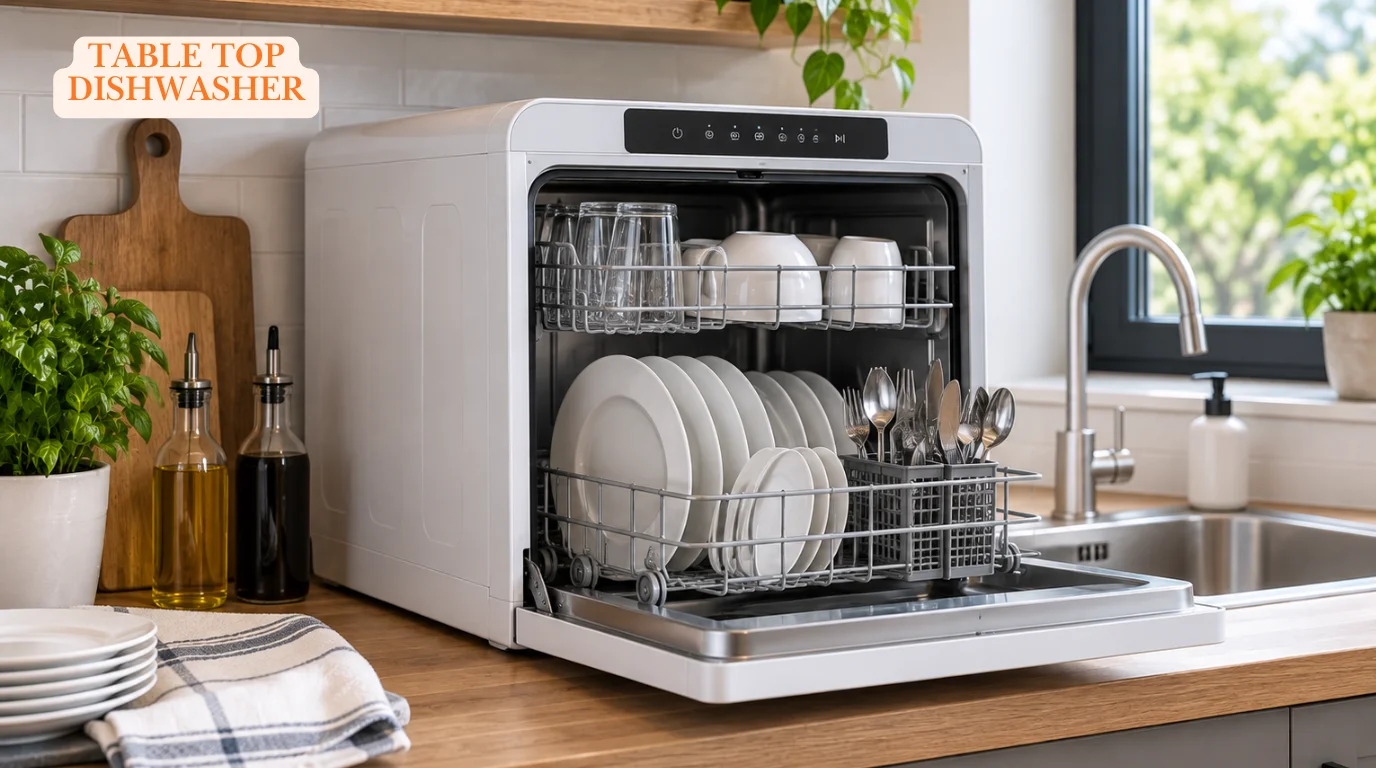
If your kitchen lacks room for a full-size appliance, a table top dishwasher can be a practical alternative. These compact machines sit on a worktop and handle smaller daily loads. UK buyers should compare space, water connection, capacity, energy data, and plate clearance before ordering.
A compact countertop machine can suit flats, rented homes, couples, and small kitchens with limited floor space. Tank-fed models can work without permanent plumbing, while larger six-place models often connect to a tap or water supply. The right choice depends on dimensions, capacity, water access, energy use, noise, and plate size.
| Table Top Dishwasher Buying Factors | What to check |
|---|---|
| Capacity | Compact models commonly offer about three to six place settings. |
| Water supply | Choose a refillable tank, tap connection, or fixed water connection. |
| Worktop space | Measure width, depth, height, and door-opening clearance. |
| Plate size | Check the manufacturer’s stated maximum plate diameter. |
| Energy | Compare the energy label and consumption per 100 eco-cycles. |
| Water | Check liters used on the eco program. |
| Noise | Compare the stated dB rating if your kitchen is open-plan. |
| Typical UK price | Many current compact options sit around £190 to £250, depending on capacity and features. |
Key Takeaways
- A built-in water tank suits renters or kitchens without an easy water connection.
- Six-place machines offer more capacity but usually require more worktop space.
- Measure your dinner plates and the appliance dimensions.
- Compare official energy labels instead of judging efficiency from size alone.
- Eco cycles normally use less energy and water, although they often take longer.
- A compact machine works well for small loads but may struggle with large pans.
- Check current prices across several UK retailers before ordering.
What Is a Table Top Dishwasher, and Who Is It For?
A table top dishwasher is a smaller freestanding appliance designed to sit on a work surface. It uses spray arms, heated water, detergent, rinsing, and drying functions much like a larger machine. Capacity is lower, so these models usually suit singles, couples, small households, and compact kitchens.
Their small format can also help renters who cannot change kitchen cabinetry or permanent plumbing. Some tank-fed models only need power, manual filling, and somewhere for wastewater to drain. Larger models may connect to a kitchen tap or a standard water supply instead.
Space still matters because the appliance takes up valuable prep space. Measure your worktop before deciding that a smaller machine will automatically fit. Topicley’s new kitchen cost and planning guide can also help when budgeting appliances during a wider kitchen change.
How Compact Countertop Machines Get Their Water
Two common water arrangements affect where you can place the machine. Tank-fed models carry an internal reservoir that you fill before starting a cycle. Connected models take water from a tap or fixed supply and drain through a hose.
Tank-fed models
- Require no permanent incoming water connection.
- Usually hold about five liters in compact models.
- Still need a safe drainage point.
- Work well where plumbing changes are restricted.
- Require manual refilling unless you use an optional tap connection.
Tap-connected or mains-connected models
- Can remove the need to refill a reservoir manually.
- Often provide larger internal capacity.
- Need a compatible connection and suitable drainage.
- Can be less flexible if your worktop is far from the sink.
The HAVA R09, for example, has a five-liter built-in tank and measures about 42.8cm by 42.5cm by 45.8cm. Its UK specification lists three place settings and Energy Class D. It was listed at £229.99 when checked in September 2026.
UK Comparison: Three Current Compact Options
Prices and availability can change, so treat this comparison as a September 2026 market snapshot. The models show how capacity, dimensions, water arrangements, and energy information vary. They are examples for comparison, not claims based on our own hands-on testing.
| Model | Capacity | Size | Useful feature | Checked price |
|---|---|---|---|---|
| HAVA R09 | 3 place settings | About 42.8 × 42.5 × 45.8cm | 5L tank and integrated water softener | £229.99 |
| Cookology CTTD6 | 6 place settings | 55 × 50 × 43.8cm | Tap or fixed water connection, 49 dB | £199.99 |
| Russell Hobbs RHTTDW6W | 6 place settings | 55 × 50 × 44cm | 6.5L eco water use, adjustable racking | £249 |
HAVA R09: Flexible Placement
The HAVA option suits homes where permanent plumbing would be inconvenient. Its five-liter reservoir gives you more freedom when choosing a position. The integrated water softener may also interest households concerned about scale and watermarks.
Pros
- Built-in water tank.
- Compact footprint.
- Energy Class D.
- Integrated water softener.
- Hot-air drying and ventilation.
Cons
- Three-place capacity is relatively small.
- Manual filling adds another task.
- Large cookware can consume most available rack space.
Cookology CTTD6: More Everyday Capacity
The Cookology CTTD6 offers six place settings and seven programs within a wider body. Cookology lists consumption at 0.61 kWh per cycle and noise at 49 dB. Its stated maximum plate size is 250mm, so check larger dinnerware first.
Pros
- Six-place capacity.
- Seven programs.
- 49dB stated noise level.
- Accepts salt and rinse aid.
- Tap or fixed-supply connection.
Cons
- Needs more counter width.
- Energy Class F.
- No built-in reservoir is listed.
- Large plates may exceed the 250mm limit.
Russell Hobbs RHTTDW6W: Another Six-Place Choice
The Russell Hobbs model also holds six place settings and measures 55cm wide. Currys lists eco water consumption at 6.5 liters and energy use at 0.613 kWh per cycle. Its listed noise level is 52 dB, making it worth comparing in open-plan homes.
Pros
- Six-place capacity.
- Adjustable racking.
- Rapid and eco programs.
- 6.5-litre stated water use.
- Widely available through UK retailers.
Cons
- Requires substantial worktop space.
- Energy Class F.
- 52 dB is higher than some comparable machines.
- Large pans can quickly reduce usable capacity.
7. Buying Checks Before You Order
- Measure the full space. Record width, depth, and available height. Allow room for ventilation, hoses, plugs, and the open door.
- Measure your largest plates. A machine can have adequate place settings but still reject oversized dinnerware. Some six-place units specify a 25cm maximum plate diameter.
- Choose your water arrangement. A refillable tank gives more placement flexibility. A direct connection removes the need for manual filling.
- Check drainage before buying. Even tank-fed machines need somewhere to send dirty water. Confirm the supplied hose reaches your intended sink or drain.
- Compare energy labels properly. UK labels show energy consumption, water consumption, program duration, capacity, and noise. That gives you better evidence than marketing descriptions alone.
- Think about your normal load. Couples may value six-place capacity if they cook frequently. A smaller tank-fed machine may suit lighter daily washing.
- Compare the total purchase price. Check delivery, warranty, accessories, and connection requirements alongside the headline price. Topicley’s washing machine sale buying guide uses the same useful principle for comparing major household appliances.
Water and Energy Use in a UK Home
Efficiency depends on the model, cycle, loading pattern, and your household tariff. Energy labels let you compare machines using the same eco-programme information. The Energy Saving Trust recommends filling dishwashers before running them and using efficient settings where practical.
Water use can be lower than many people expect from an automatic appliance. Which? reported that dishwashers in its testing used almost 80% less water per full wash than handwashing. That figure covers its tested machines, so check the specific compact model rather than assuming identical savings.
The label also helps you compare models without guessing from physical size. A small body doesn’t automatically guarantee a higher efficiency grade. Compare kWh per 100 cycles and liters per eco cycle before deciding.
When a Compact Machine May Not Be Large Enough
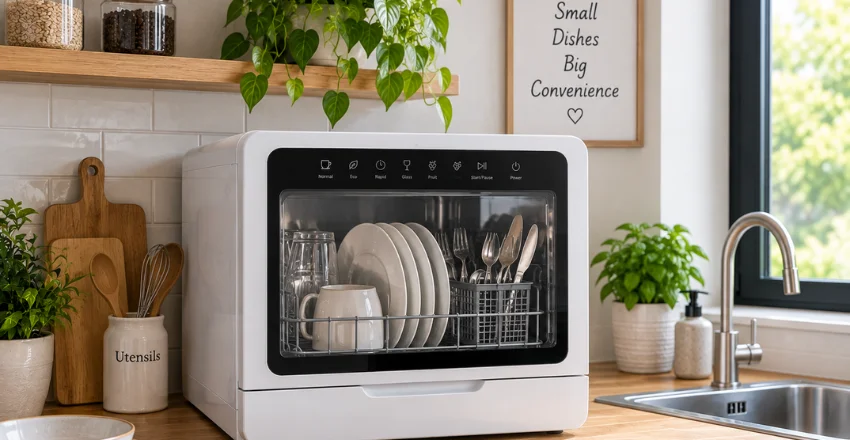
A countertop model can become frustrating if you regularly wash large cookware. Frying pans, casserole dishes, mixing bowls, and tall glasses quickly take up rack space. A stated place-setting number does not show how your own kitchenware will fit.
Larger households may also need several daily cycles to clear their dishes. That can reduce the convenience gained from choosing a smaller appliance. A slimline floor-standing model may make more sense if you have suitable cabinet or floor space.
Worktop value matters too, especially in a small kitchen. Losing half a meter of preparation space can create a new problem while solving the washing-up issue. Compare the appliance footprint with the surface area you use every day.
Practical Verdict for UK Buyers
Choose a tank-fed model when plumbing flexibility matters more than maximum capacity. This setup makes particular sense for renters, caravans, temporary kitchens, and awkward sink layouts. A five-liter reservoir can remove the need for a permanent incoming water connection.
Choose a six-place connected machine when you want more room for everyday plates and cups. These units suit couples and small households that generate larger daily loads. They also make sense when a convenient tap or fixed connection is already available.
Neither format suits every kitchen, so dimensions should come first. Measure your space and plates, then compare energy, water, noise, and warranty data. That approach is more useful than choosing by appearance or program count alone.
Make the Final Measurements Before Buying
Before buying a table top dishwasher, measure the worktop and your largest everyday plates. Check where the inlet, drain hose, plug, and open door will sit. Then compare current prices and official energy information between models that genuinely fit.
A compact appliance can remove a repetitive kitchen chore without requiring full-size installation space. Its usefulness depends more on correct sizing and setup than a long feature list. For more household planning ideas, browse Topicley’s Home Improvement guides.
Frequently Asked Questions
Do I need plumbing for a countertop dishwasher?
Not always, because several compact models include refillable internal water tanks. These machines can take clean water manually and discharge wastewater through a hose. Other models need a tap or fixed incoming water connection, so check the specification carefully.
Are countertop models worth buying for one or two people?
They can be useful when washing-up volume is modest, and kitchen space is limited. The smaller rack is easier to fill without storing dirty dishes for several days. Value still depends on worktop space, purchase price, and how often you expect to run it.
Can a compact machine fit normal UK dinner plates?
Many can, but the maximum plate diameter varies between models. Current six-place examples from Cookology and Russell Hobbs list a maximum of about 25cm. Measure your largest plates before ordering rather than relying only on place-setting capacity.
Does a smaller machine always use less electricity?
Not necessarily, because efficiency depends on design and cycle performance. Compare the official energy grade and kWh figure instead of assuming physical size determines consumption. The Energy Saving Trust explains that dishwasher labels provide comparable eco-cycle energy, water, capacity, duration, and noise information.
Should I choose a water tank or tap connection?
Choose a tank when flexible placement and minimal plumbing matter most. Choose a direct connection when convenient water access and reduced manual filling matter more. Your available space, load size, and sink position should guide the decision.