
Beef tallow for skin has re-emerged as a traditional, low-ingredient skincare option amid growing interest in natural and minimalist beauty routines. Rendered from cattle fat, beef tallow functions primarily as an occlusive emollient that helps seal moisture into the skin and support barrier integrity.
Its lipid profile, rich in fatty acids and cholesterol similar to those found in the skin’s outer layer, may aid hydration, soften rough texture, and protect against environmental dryness. While many users value tallow for its simplicity and effectiveness in soothing dry, chapped skin, understanding its composition, benefits, limitations, safety considerations, and proper usage is essential for achieving the best results and avoiding potential drawbacks.
| Category | Key Points |
| Beef Tallow For Skin | Rendered cattle fat is used as an occlusive moisturizer |
| Primary Function | Seals moisture & protects the barrier |
| Main Lipids | Stearic, palmitic, oleic acids |
| Other Components | Cholesterol & trace vitamins A, D, E, K |
| Texture | Semi-solid, balm-like consistency |
| Skin Benefits | Hydration, barrier support, softening |
| Barrier Support | Reduces transepidermal water loss (TEWL) |
| Emollient Effect | Softens rough, cracked skin |
| Sebum Compatibility | Similar lipids to natural skin oils |
| Best Uses | Dry hands, feet, elbows, and chapped skin |
| Compared to Moisturizers | Lacks humectants & ceramides |
| Who Should Use Carefully | Acne-prone, sensitive, eczema-prone skin |
| Potential Risks | Greasiness, clogged pores, contamination |
| Safety Tips | Patch test & use a thin layer |
| Storage | Airtight container, cool & dark place |
| DIY Note | Small batches reduce spoilage risk |
| Evidence Level | Limited clinical research |
| Best Alternative | Ceramide barrier creams for repair |
Beef Tallow For Skin
Beef tallow for skin is rendered cattle fat, traditionally used for cooking and skincare. Renewed interest in natural and low-ingredient skin care has brought tallow back into use as an occlusive emollient that may support barrier repair due to its fatty acid and cholesterol content.
Composition and key lipids
- Beef tallow is composed mainly of triglycerides.
- Its fatty acid profile is dominated by stearic acid, palmitic acid, and oleic acid.
- It contains smaller amounts of palmitoleic acid and linoleic acid.
- Tallow also includes cholesterol.
- Trace amounts of fat‑soluble vitamins (A, D, E, K) are present; levels vary with the animal’s diet.
- Grass‑fed tallow typically has higher vitamin E and beta‑carotene than grain‑fed tallow.
- The saturated-to‑unsaturated fat ratio makes tallow semi‑solid at room temperature.
- Compared with highly polyunsaturated oils, tallow is relatively stable against oxidation.
How Does Tallow Benefit The Skin?
Barrier Support and TEWL Reduction
Beef tallow forms an occlusive layer on the skin that helps reduce transepidermal water loss (TEWL). By slowing moisture evaporation, it supports hydration and protects dry, chapped, or weather-damaged skin. This protective sealing effect can be particularly beneficial in cold or low-humidity environments where the skin barrier is easily compromised.
Lipid Replenishment and Barrier Repair
Tallow contains fatty acids and cholesterol that resemble components naturally found in the stratum corneum, the skin’s outer protective layer. These lipids may help replenish barrier function and improve resilience, although tallow does not contain ceramides, which are also essential for optimal barrier repair.
Emollient Properties and Texture Improvement
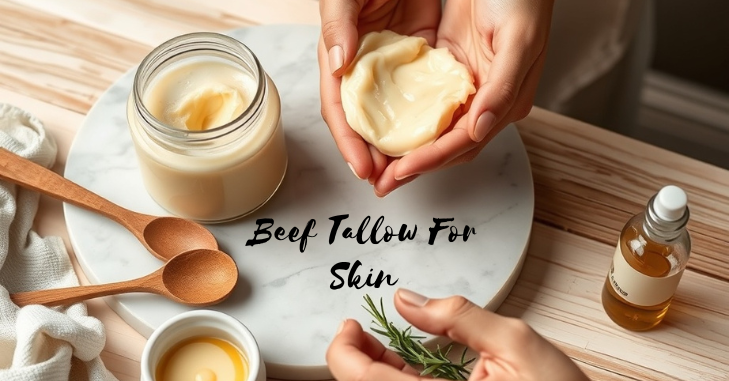
With its rich, balm-like consistency, beef tallow fills microfissures in rough or cracked skin and softens hardened areas. This emollient action makes it especially effective for smoothing dry hands, heels, elbows, and other areas prone to rough texture.
Sebum Compatibility
Beef tallow shares certain lipid components with human sebum, including oleic and palmitoleic acids. This similarity is often cited as a reason it may be well tolerated by some skin types and capable of supporting the skin’s natural oil balance when used appropriately.
Minor Bioactive Compounds
Tallow contains trace amounts of palmitoleic acid and fat-soluble antioxidants, which may provide modest antimicrobial and antioxidant effects. However, the clinical significance of these bioactive compounds remains limited, and they should be viewed as supportive rather than primary therapeutic benefits.
Raw comparison with commercial moisturizers
Formulation complexity. Commercial moisturizers typically include humectants (glycerin, hyaluronic acid), emollients, occlusives, and active ingredients (ceramides, niacinamide) designed for targeted outcomes. Tallow is primarily an occlusive/emollient without added humectants or ceramides.
For severe dryness and chapping, tallow can be effective; for barrier-repair protocols that rely on specific ceramide:cholesterol: fatty acid ratios, evidence favors formulated barrier creams.
Tallow is heavier and greasier; many consumers prefer the lighter textures of modern creams for daytime use. Properly rendered tallow is stable, but homemade batches risk rancidity or contamination; commercial products often include stabilizers/preservatives.
Safety, risks, and who should be cautious
- Tallow’s occlusiveness can worsen comedonal acne in susceptible individuals; test cautiously on facial areas prone to breakouts.
- True allergy to rendered beef fat is rare, but those with red-meat allergy or alpha-gal syndrome should exercise caution and consult a clinician.
- Poor rendering or storage can introduce microbes; hygienic preparation and airtight storage are essential.
- Tallow is animal-derived and unsuitable for vegans or those with cultural/religious objections.
How to use beef tallow safely?
Sourcing and quality. Prefer cosmetic-grade or high-quality grass-fed sources if possible. Rendering. Use low-heat, slow rendering and strain impurities; commercial cosmetic-grade tallow reduces homemade risks. Apply to a small area (inner arm or behind ear) for several days before facial use.
Use a thin layer on clean, dry skin; for optimal hydration, apply a humectant first (e.g., glycerin or hyaluronic acid serum), then seal with a light layer of tallow. For the face, start conservatively (once or twice weekly) and monitor for breakouts or irritation. Keep in an airtight container away from heat and light; refrigerate for long-term storage if desired.
DIY balm recipe (simple, measured)
Basic tallow balm (small batch): 85% rendered beef tallow, 15% sunflower or rosehip oil (adds linoleic acid and improves spreadability), 0.5% vitamin E (antioxidant). Melt and mix gently, pour into sterilized jars, cool, and label with date. Use clean spatulas to scoop product. Note: DIY products carry contamination and stability risks; use small batches and discard if rancid.
Evidence and limitations
- Clinical trials directly testing beef tallow for skin conditions are scarce.
- The theoretical rationale for tallow use is based on lipid science: supplying fatty acids and cholesterol that may assist barrier repair.
- Tallow does not contain ceramides, which are key lipids in the stratum corneum important for barrier function.
- Well-studied occlusives (e.g., petrolatum) have clear evidence for reducing transepidermal water loss (TEWL); tallow likely acts as an occlusive in a similar way.
- Tallow lacks standardized, peer-reviewed comparative studies against established barrier-repair products.
- Most support for topical tallow is anecdotal or based on extrapolation from basic lipid biology rather than controlled clinical data.
- Therefore, while plausible as an occlusive/emollient, tallow’s clinical efficacy and safety profile are less well documented than commercial, evidence-backed barrier creams.
When to choose tallow and when to choose alternatives?
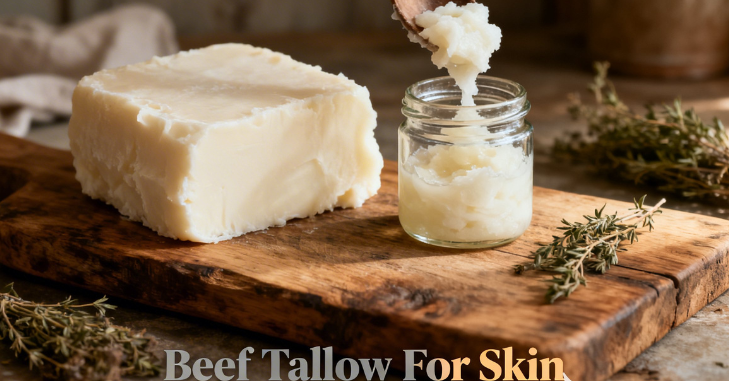
Choose tallow when you seek a simple, traditional occlusive for very dry, chapped skin or for body areas (hands, feet, elbows) where rich balms are acceptable. Avoid or test cautiously on acne-prone facial skin.
Prefer commercial barrier creams containing ceramides and humectants for eczema, chronic barrier dysfunction, or when you need proven clinical results. Opt for plant-based butters (shea, mango), petrolatum, or ceramide formulations if you avoid animal products or need low-comedogenic options.
Regulatory and ethical notes
Cosmetic-grade tallow from reputable suppliers will meet regulatory and safety standards more consistently than homemade preparations. Consider sustainability and animal-welfare sourcing if these issues matter to you. Clearly label any DIY product and avoid sharing between people to minimize cross-contamination.
Conclusion
Beef tallow is a potent, traditional occlusive with a fatty acid and sterol profile that may support barrier function and provide long-lasting emollience for very dry skin. It is best used thoughtfully: source quality fat, render and store hygienically, patch-test, combine with humectants for better hydration, and avoid heavy facial use if acne-prone.
While practical and valued by many for simple, low-ingredient skincare, beef tallow lacks the robust clinical trial evidence that supports modern barrier-repair formulations containing ceramides and humectants. If you want, I can provide a detailed step-by-step rendering guide, a few alternate DIY formulations (face vs body), or an evidence-backed list of commercial barrier creams matched to your skin type.
If you want to read an interesting article about it, explore our Fashion category.
FAQs
Vitamins A, D, E, and K are abundant in beef tallow, as are vital fatty acids that provide the skin with deep nourishment and hydration. It is very absorbable due to its composition, which is very similar to that of human sebum. In addition to promoting smooth, hydrated, and youthful-looking skin, it aids in inflammation reduction and skin barrier repair.
Using our balm twice a day (morning and night) is usually helpful if you have dry or normal skin. Because tallow is richly occlusive, you may decide to use it nightly or every other night if you have oily or combination skin. If you’re new to tallow skincare, always do a patch test.
Important lessons learned. Like the natural oils of the skin, beef tallow contains essential vitamins and fatty acids. Although there isn’t any concrete proof, its moisturizing and anti-inflammatory qualities might help eczema-prone skin.
Whiteheads, blackheads, cystic acne, and general congestion can result from tallow clogging pores. The goal of dermatology is to support the skin barrier while letting it “breathe,” and the density of tallow contradicts this objective.